
If the concerns over risking political capital are overcome, the long-term gains for the Indian economy will be immense, asserts A K Bhattacharya.

However, financial flows to the economy remained constrained because of decline in the amount of equity finance raised from the capital markets and stress in the NBFC sector, Finance Minister Nirmala Sitharaman pointed out.

The banking sector is set to move at a fast pace from hereon.

The finance ministry on Thursday raised concerns over the possible impact of El Nio conditions on India this year, saying if recent forecasts came true, the country could see lower agricultural output and higher inflation. "Some meteorological agencies predict the return of El Nio conditions in India this year. "If these predictions are accurate, then monsoon rains could be deficient, leading to lower agricultural output and higher prices," the ministry said in its monthly economic review.

'We don't have to go abroad for anything.' 'Anyone who thinks we have a lot to learn from the US needs to have his head examined.' 'We are in a new era.'

Elections may be a few months away, but the government may get into election mode much earlier than that, predicts A K Bhattacharya.
FM says government policies aim to contain inflation, spur growth.

Armed with necessary macro and micro growth drivers, India is on its way to becoming the fastest growing major economy in the world, a finance ministry report said. Rapid vaccination and teeming festivities will push India's ongoing recovery resulting in narrowing of demand-supply mismatches and greater employment opportunities, as per the monthly Economic Review prepared by the ministry.

He will be the eighth Deputy Governor to be made Governor at RBI
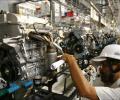
India's economy grew at 7.6 per cent in 2015-16.

The rupee on Tuesday recovered from its all-time intra day low of 77.79 to close higher by 7 paise on a stellar rally in domestic stock markets. After opening lower at 77.67, the local unit plunged further to its all-time intra-day low of 77.79 due to a spike in crude oil prices and disappointing macroeconomic data. However, a strong rally in domestic equities helped the rupee rebound and close at 77.48 (provisional), showing net gains of 7 paise over the last close of 77.55. The forex market was closed on Monday on account of Buddha Purnima.

At the same time, the UN said in a report, the performance of private investment remains a key macroeconomic concern.

'Investors should hold equity assets for 3 to 5 years.'

Headline inflation will come down under the 6 per cent mark in July itself but will stay at an elevated level of over 5 per cent for some time, Chief Economic Advisor K V Subramanian said on Thursday. Such an outcome will get the price rise back into the upper-end of the target band given to RBI, he said, adding that consumer price inflation had breached the mark for three consecutive quarters last fiscal because of supply side issues like challenges in movement of goods. "With reasonable probability, I expect this month the (inflation) print to come less than 6 per cent," Subramanian told a conference organised by industry lobby Ficci. Right after data for May showing inflation at 6.4 per cent had come out, Subramanian said he had predicted it will cool down in internal meetings and also during "deliberations with the regulator".

The benchmark Sensex is 2.4 per cent shy of a new lifetime high but the market capitalisation (m-cap) of all companies listed on the BSE is already in the record books. At Thursday's (August 18) closing price, the total m-cap of 4,776 firms on the BSE stood at Rs 280.5 trillion, surpassing the previous high of Rs 280 trillion on January 17. This, even if the Nifty Midcap 100 is currently 5.4 per cent below its lifetime high, while the Nifty Smallcap 100 index is down over 20 per cent.

Benefitting from the economic rebound, banks are expected to report a healthy bottom-line and asset quality profile in the quarter ended March 2023 (Q4FY23). The net profit of listed commercial banks is projected to grow by an average 43.6 per cent year-on-year (YoY) in Q4FY23 amid better net interest margins (NIMs) and declining credit costs. This is based on a combined assessment of analyst estimates for 17 banks on Bloomberg database.

A total of 183 stocks rallied 10 per cent, of which 32 stocks saw price appreciation of 20 per cent each.

India's exports contracted by 22 per cent, the steepest decline in the last three years, to $32.97 billion in June on account of global demand slowdown, especially in the Western markets like the US and Europe. According to the data of the commerce ministry, the trade deficit in June stood at $20.3 billion against $22.07 billion in the same month last year due to a fall in exports and imports. The inbound shipments during the month under review declined by a steep 17.48 per cent to $53.10 billion.

The Indian services sector activity fell to a six-month low in September, as new business inflows rose at the slowest rates since March, amid inflationary pressures and competitive conditions, a monthly survey said. The seasonally adjusted S&P Global India Services PMI Business Activity Index fell to 54.3 in September, from 57.2 in August, highlighting the weakest rate of expansion since March. For the fourteenth straight month, the services sector witnessed an expansion in output. In Purchasing Managers' Index (PMI) parlance, a print above 50 means expansion, while a score below 50 denotes contraction.

'Although mid- and small-cap funds have the potential for higher growth, they come with inherent higher volatility.'

Chidambaram said there was no tension between the finance ministry and the Reserve Bank of India.

Foreign portfolio investors (FPIs) remained net buyers to the tune of Rs 12,266 crore in the Indian market in the first five trading sessions of February, as positive sentiment post-Union Budget 2021 sparked a rally in investment.

Amid imminent phasing out of the fiscal stimulus by US Federal Reserve, Prime Minister Manmohan Singh on Wednesday called for an "orderly exit" from unconventional monetary policies being pursued by the developed world for the last few years to avoid damaging growth prospects of the developing world.

The RBI governor-designate may be economical with spoken words, but is known for his sharp and critical writings

Commodity investments can help you diversify your portfolio in asset classes other than equity and debt, says Dwaipayan Bose.

Investors may take a 5 to 10 per cent exposure to silver. 'Have a long-term investment horizon when investing in silver ETFs to ride out short-term market fluctuations.'

'The Reserve Bank's independence has remained a work in progress, an enduring challenge that the nation has been grappling with on an ongoing basis,' says RBI Deputy Governor Dr Viral Acharya.

Consumer goods firms and auto companies are witnessing an upturn in rural demand, which had been lagging for most of FY24. Expectations of a bumper rabi crop harvest have helped turn the tide. The Reserve Bank of India's (RBI's) Monetary Policy Committee kept the repo rate unchanged last week, noting that as rural demand catches up, consumption is expected to support economic growth in 2024-25.

The principal challenge for Rajan's successor is to work with the Bank Board Bureau and the finance ministry to complete these processes of banking reform.

Firms seem to have adopted a wait-and-see approach on their plans until public policies become clearer upon the formation of a government.

Amid uncertainties arising out of the second wave of COVID-19, the Reserve Bank on Thursday said that a durable revival of private consumption and investment would be critical for sustaining economic growth post-pandemic. Observing that 2020-21 has left a scar on the economy, RBI in its annual report said, "in the midst of the second wave as 2021-22 commences, pervasive despair is being lifted by cautious optimism built up by vaccination drives." The second wave of the pandemic has prompted revision of growth projections for the current fiscal and the consensus appears to be gravitating towards RBI's forecast of 10.5 per cent, the report added.

While banks are not as exposed as the corporate sector during the initial stage of the pandemic, the strain on lenders could ultimately be profound. Banks face a second-order hit compared with the corporate and household sectors.

IMF chief Horst Kohler, who is in Dubai to World Bank Group and IMF meetings, did not comment on the issue of BPCL and HPCL divestment.

Till now, the maximum Bharat Ratnas were awarded in 1999 when four recipients were given the coveted award.

Growing at a robust rate due to economic reforms in key sectors like digitisation and infrastructure, India has emerged as a star performer and is projected to contribute more than 16 per cent of the global growth, the International Monetary Fund said on Monday. "What we have been observing for quite some time now is that India has been growing at a very robust rate. "It's one of the star performers when it comes to real growth when you look at peer countries.

Titan was the top gainer in the Sensex pack, rising 3.5 per cent, followed by Kotak Bank, SBI, Maruti Suzuki, Bajaj Finance, HUL, Axis Bank and Sun Pharma. On the other hand, NTPC, Tech Mahindra, PowerGrid and Infosys were the laggards.

An aggressive rate hike by the US Fed and the possibility of a recession can trigger a slide in these stocks, which will be a good opportunity to buy from a long-term perspective.

Government hits back, tells rating agency to introspect on processes.
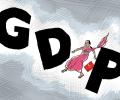
India's Gross Domestic Product (GDP) is expected to expand by 9.2 per cent in the current financial year, according to the Economic Survey 2021-22 tabled in the parliament on Monday. "Advance estimates suggest that the Indian economy is expected to witness real GDP expansion of 9.2 per cent in 2021-22 after contracting in 2020-21. "This implies that overall economic activity has recovered past the pre-pandemic levels," Economic Survey noted. Almost all indicators show that the economic impact of the "second wave" in Q1 was much smaller than that experienced during the full lockdown phase in 2020-21 even though the health impact was more severe, it said.

HSBC's purchasing managers' index was released on Tuesday.
